
When Mitsubishi Corporation said in February 2025 that it was “reviewing the business plans for our Japanese offshore wind power generation projects due to material changes in the macroeconomic environment,” the previously unthinkable became plausible.
Having unsuccessfully considered options including a schedule revision and a switch to the feed-in-premium (FIP) scheme that would allow the projects to sell their output under corporate PPAs instead of at the awarded feed-in-tariff (FIT) prices, the plausible then became the reality within a few months.
The trading company announced its withdrawal from all three areas awarded in Round 1, noting that “after discussions among the partners, we have determined that establishing a viable business plan is not feasible given the current conditions.”
Mitsubishi allowing the country’s flagship energy projects to fail shocked some. Others, particularly those who criticized the winning consortia for submitting unrealistically low bids since the results became known, were less surprised.
The withdrawal left the government not only with a 1.7GW gap to fill but also with the task of proving that offshore wind in Japan could, indeed, work under the right conditions. The Ministry of Economy, Trade and Industry (METI) promptly began reviewing what happened and architecting changes to prevent similar outcomes in future rounds, including in the re-auctioning of Round 1 areas.
This article examines the key reason behind the concentration of all three projects into the hands of consortia led by the same company, the way the regulator plans to prevent a recurrence of the first round’s failure, and the price ranges at which operators might participate in the next round.
Bid price scoring system recalibration
Bids in tenders for offshore wind projects in areas under the Act on Promoting the Utilization of Sea Areas for the Development of Marine Renewable Energy can receive up to 120 points for the price scoring criteria and up to 120 points for all non-price criteria combined.
In the first auction round, the lowest bid for an area was awarded the full 120 points in the price component, with the points received by all other bidders determined by the gap between their price and the lowest price. The mechanism favored aggressive underbidding that would lead to significant score gaps between the lowest bidder and other participants.
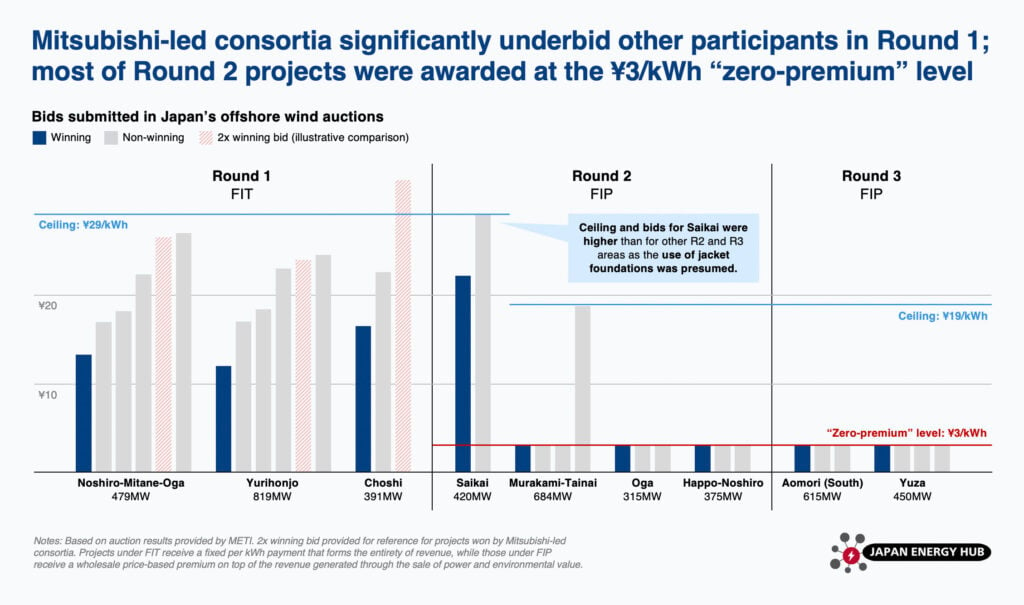
The consortia of Mitsubishi and Chubu Electric Power group companies (and for the Yurihonjo project in Akita also the Hokuto Bank-affiliated Venti Japan) bid for all three projects at prices between 22% and 30% lower than the second highest bidder.
By doing so, they not only secured the full 120 points but also a significant gap of over 35 points versus the 83.7 to 87.6 points received by the second highest bidders for the three offered projects. For comparison, the gap between the Mitsubishi-led groups, which also received the highest non-price scores for all three projects, and the consortia with the second highest non-price scores were only 7 to 10 points.
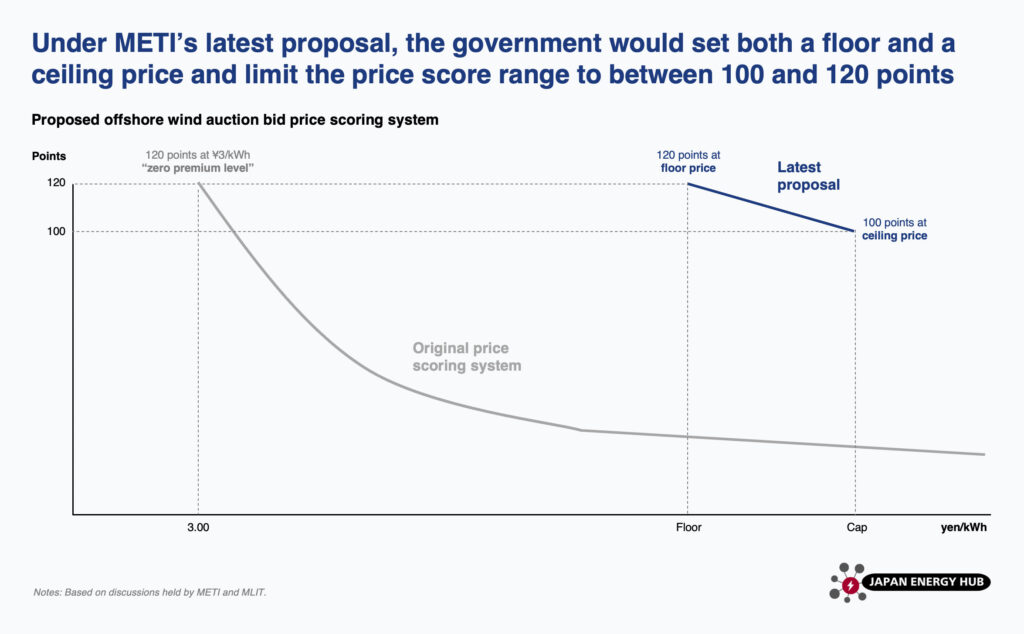
From the next round, METI plans to avoid the “race to the bottom” by introducing a new price scoring system, which would prevent a single low bid from having a significant effect on the overall ranking and prioritize project economics over unrealistic bids.
Instead of the score being anchored to the lowest bid submitted by one of the participants and unknown to others at the time of bidding, the government would set not only a ceiling but also a floor price in advance.
It would also limit the price score range to between 100 and 120 points, shrinking the maximum possible score gap between bidders. Companies participating at the floor would secure the full 120 points, while those bidding at the ceiling would still receive 100 points. The score would decrease linearly for prices between the two extremes.
METI also plans several changes to the non-price scoring system, deprioritizing speed of implementation and instead putting increased focus on project execution plans and power supply stability.
Past round bidding behavior and developers’ expectations
While Round 1 became notorious due to Mitsubishi’s sweeping win at prices that many believed were unfeasibly low, the scoring mechanism’s flaw was even more evident in Round 2 following the shift from FIT to FIP contracts.
Five out of six projects in the second tender were awarded at the 3 yen per kWh “zero-premium” level, at which bidders expected to receive no premium on top of the revenue from power and environmental value sales. Only three of the 19 participants bid higher.
In Round 1, operators, at least in theory, bid what they considered to be a viable fixed offtake price for them to make an acceptable return. In Round 2, they mostly bid to secure the rights to develop the project, with the intent of finding corporate PPA offtakers willing to pay prices that would make the projects viable with minimum subsidy.
Satoru Harada, the Head of Power Division at Marubeni, a member of the consortium that won the 450MW Yuza project in Round 3, told Nikkei GX in March 2025 that the company wanted to look for PPA offtakers willing to pay no less than 20 yen per kWh, providing one benchmark for what operators’ expectations might be.
At a press conference following Mitsubishi’s withdrawal, CEO Katsuya Nakanishi said it would have been difficult for the company to continue developing the Round 1 projects even at FIP strike prices more than double the awarded FIT levels, without elaborating further.
Notably, for the 479MW Noshiro-Oga-Katagami and 819MW Yurihonjo projects, even double the awarded Mitsubishi-led consortia prices would still have only been the second highest bids for the respective area.
Offshore wind analytics firm Aegir Insights said its modeling suggests that Round 1 projects could potentially make a 10% equity post-tax nominal internal rate of return under at overall revenues ranging between 21.9 and 24.0 yen per kWh. “The Yurihonjo site stands out as the most competitive of the sites,” the Denmark-based company added.
Balancing the revenue stack
The price scoring system’s revision should lead to bids reflecting likely project reality more accurately than the unfeasibly low fixed tariffs awarded in Round 1 and the zero-premium FIP contracts fully relying on the winners’ ability to secure PPAs awarded in Round 2.
Bidders in Round 1 areas’ re-auction and other future rounds will still be looking to secure stability through long-term corporate PPAs and securing non-zero-premium contracts could allow them to offer more favorable terms to offtakers than their Round 2 and 3 peers can.
At the same time, they will also need to account for the reality of the PPA market, including the gap between sellers’ and buyers’ price expectations and average deal sizes, which might prevent them from finding offtakers for their multi-hundred megawatt projects’ entire output as quickly as they would like, inevitably leaving them partially exposed to the market.
It is at those times that a reasonable FIP strike price, which the introduction of a floor price should deliver if set appropriately, will have the potential to save project economics. A luxury that most Round 2 and 3 winners do not have.
Correction (March 15, 2026): A previous version of this article incorrectly indicated that Mitsubishi-led consortia bid between 28% and 42% lower than the second highest bidder rather than 22% and 30%. It also included a duplicated later section in “Bid price scoring system recalibration” instead of the actual text.
Correction (March 17, 2026): A previous version of this article stated that Aegir modeled FIP strike prices of 12.6 and 14.6 yen per kWh. These figures instead refer to average FIP premiums received on top of market revenues, rather than strike prices.
