
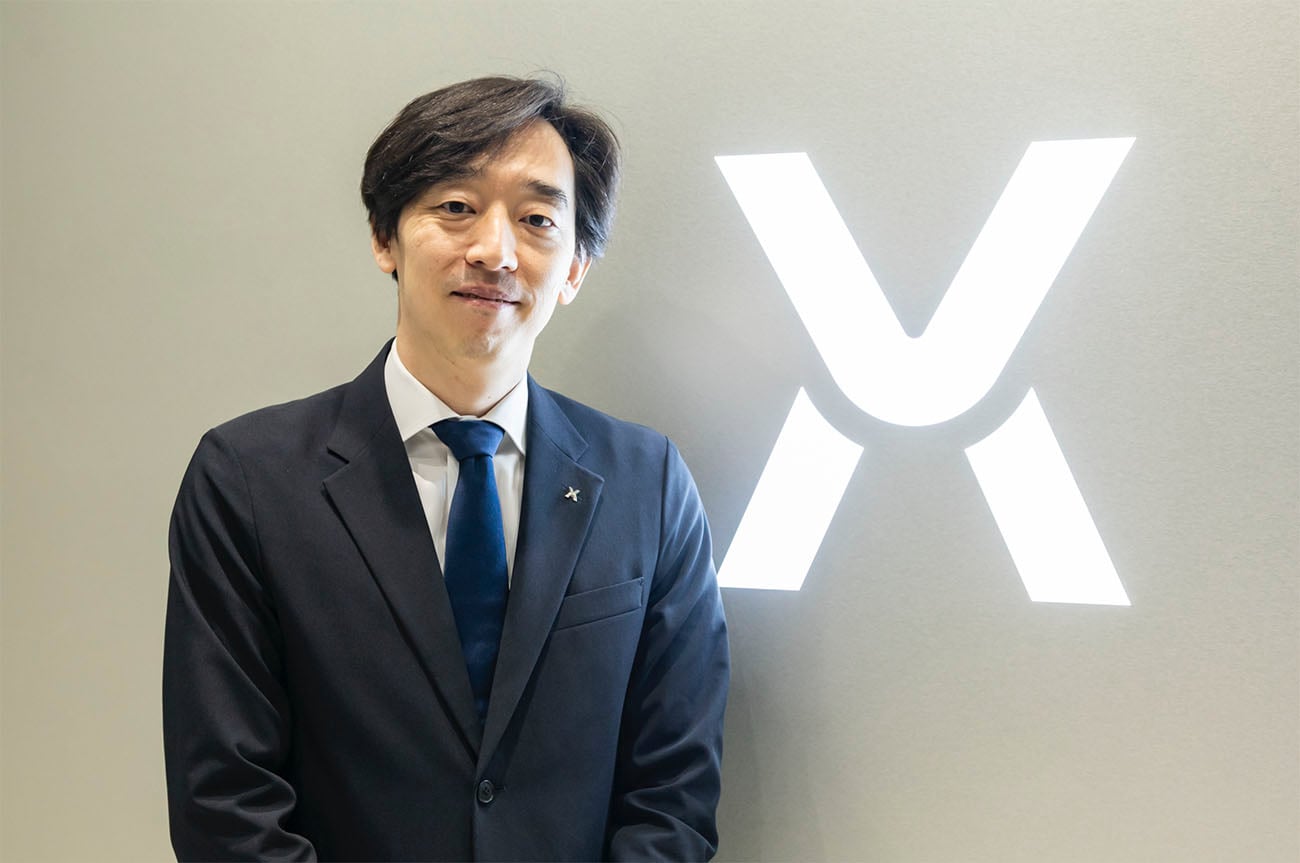
“It would have been great to have solar on our roof and a battery but I couldn’t do it. I realized that nobody makes ESS.” That moment of frustration at ZOZO, Japan’s e-commerce giant that acquired Masahiro Ito’s previous venture, became an early insight behind PowerX. From his research in English, energy storage appeared to be a solved problem. Yet, in Japan, it wasn’t happening.
He launched PowerX in the spring of 2021, and since then, grown it into a Tokyo Stock Exchange-listed battery system manufacturer trusted by some of the country’s largest renewable energy players. The company also has sights on growing in other segments crucial for achieving what Ito calls “energy prosperity.”
In a wide-ranging conversation with Japan Energy Hub, he reflected on his entrepreneurial journey and shared his outlook on the Japanese power market.
We talked about: An outsider’s perspective | Building trust, one layer at a time | Energy prosperity | Hardware, software, services | Selling storage in Japan and beyond | Markets and bankability | Control matters more than cells | Where energy and compute meet
An outsider’s perspective
Ito founded Yappa, his first startup that developed 3D graphics technologies, out of high school in 2000. “Anything internet was hot,” he recalled about the environment at the time. Fourteen years later, ZOZO, then known as Start Today, acquired the company.
Being part of the founding family of one of Japan’s largest food companies, Itoham, entrepreneurship runs in Ito’s blood. “[My grandparents] were fishermen in Yokkaichi, and they created a sausage out of fish meat. They found a way to package it freshly, and that’s what took off,” he explained. “It was, actually, technology innovation at the time.”
Following the M&A of Yappa, Ito remained at ZOZO for seven years, serving as a board member for four and ending his tenure as the Chief Operating Officer. The acquisition gave him a chance to watch up close the e-commerce company’s market cap increase multiplefold.
“I was able to experience a super high-growth, listed startup that was still taking lots of risk and growing exponentially. Growing really, really fast,” Ito recalled the previous chapter of his career. “It was a great experience, completely different to what I do now.”
The experience, while different, provided him with the early insight that contributed to PowerX’s founding. Ito remembered a significant trend in investors mandating ESG compliance at the time, prompting ZOZO to explore sustainability and renewables. He said it was then that he learned about what Japan’s power generation mix looked like and how much the country relied on imported fuel.
This was the first time in my life that I realized that, my goodness, Japan runs on oil, gas, and coal.
At the same time, Ito encountered the lack of battery storage solutions in the Japanese market. “Okay, well, I have to do something in this space,” he says he thought at the time. “And so I left ZOZO and I started PowerX, and it’s been about five years since then.”
Building trust, one layer at a time
According to Ito, entering the battery business without a background in energy allowed him to “question the most fundamental things about the industry, and sometimes those things are worth questioning.”
When asked about the challenge of breaking into the energy industry as an outsider, Ito stressed the need to focus on flawlessly executing the customer journey, from quoting through delivering the product, all the way to the afterservice. “Everything has to be there,” he said, adding that “it’s really just one thin layer of trust at a time.”
At the same time, Ito remained realistic, saying that it would have been difficult to quickly capture a significant market share were there more competitors. He said that battery storage “just happened to be a fairly sparsely populated industry,” noting that as the market developed, PowerX ended up being one of the most experienced companies.
Even five years is a lot of experience for an industry that’s only five years old. So I would attribute [our success to] us entering at the right time.
Ito’s focus on “layering trust” through even the smallest details was evident in the passion with which he spoke about PowerX’s brand and visual identity.
“I subscribe to the notion that the future should be exciting. I love engineering. I love humans challenging physics, up to the point where we’re doing amazing new things that make our lives better. So I really like technology, and the future needs to look cool,” he lit up when asked about PowerX’s focus on design.
He said that the company has a creative director internally, explaining that “the same guy that designed our logo designs all our products, our offices. We actually even have our own font that we use. And we try to tie it all together because that’s one way to communicate a corporate vision. I want the corporate vision to seep through everything we do.”
Energy prosperity
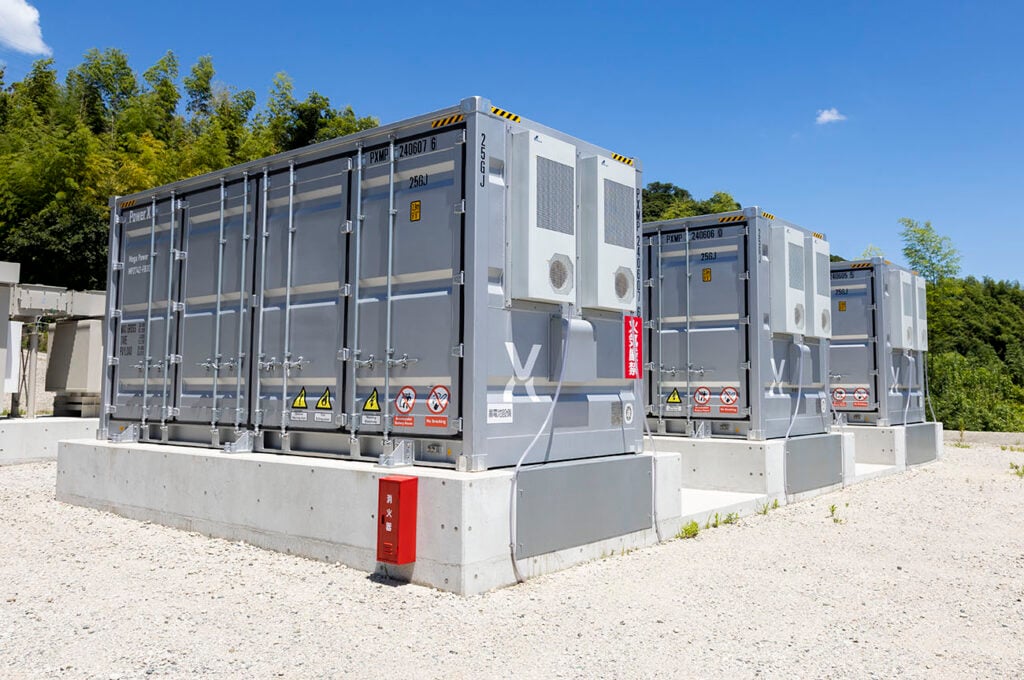
Accounting for about 90% of the company’s revenue, battery system manufacturing is the bread and butter for the PowerX of today. For Ito, it is one of the means to achieve his vision of “energy prosperity.” Storage helps lower energy costs, he said.
If we can lower energy costs, we can boost GDP. We can boost income. Everything is better if energy is cheaper.
Ito noted that with lower energy costs comes a more prosperous society. He also added that he seeks to make Japan more energy independent.
“I believe that a cool future is something where we’re able to use as much energy as we need to, to flourish, to increase the population, to increase our way of life, and to have a better life as humans without destroying our environment.”
He distilled the vision into a set of questions he asks himself when thinking about PowerX’s direction: “Is this prosperous for society from an energy perspective? And if it is, can we make a difference? Is it worth it for us to jump in?”
With those questions in mind, Ito listed batteries and data centers as the two segments of interest at the moment. “But I’m sure there’s a lot,” he added while highlighting that the company is currently also doing direct current-related research and development.
“Batteries are all DC. Data center computers are all DC. We’re going to see way more demand for AC-to-DC and DC-to-DC conversion. DC safeguarding is also very important,” Ito said. “So there’s lots of different areas that we think we could enter.”
Hardware, software, services
Expanding on PowerX’s role in the energy ecosystem, Ito explained that the world operates in cycles where hardware leads and software follows.
“You need a camera and a screen on all humanity, and then Instagram makes sense, right? It’s always hardware first,” he said, arguing that the principle applies in energy too, with software creating meaningful value only once the underlying hardware is in place. For Ito, that is computers and batteries.
Ito pointed to data centers and, in particular, curtailing their energy use for fast-response frequency regulation, as an example. “It takes more than 10 seconds for a computer to shut down, it takes like 40, so there is no way you can do it in software,” he explained.
You need batteries. You need physical hardware to assist that shutdown. So for the next 10 years, I think, hardware.
While battery manufacturing and related control software development remains at PowerX’s core, the company has also been expanding into services such as aggregation, tolling, and power retail. For Ito, that is not a shift away from, but a natural extension of the main business.
“What we feel is what our customers really want is not physically the battery. They want what the battery can do. They want energy arbitrage. They want FCR. And that is a whole service,” he said.
Ito highlighted vertical integration as being the company’s key advantage. “Us doing services is actually great for the hardware too because we get to monitor it. We get to see how the customer uses it, and we can make new changes by listening and looking at that data.”
From a financial perspective, he expects battery manufacturing growth to outpace services for now, but sees them as an important part of the revenue mix nonetheless.
When we have a down year, when there’s a really bad economy and people can’t do new CAPEX, services will help us.
Ito said he wants to build up the services business to 15% or 20% of the company’s annual revenue to create a recurring revenue base to lean on and to maintain longstanding relationships with customers.
Selling storage in Japan and beyond
About half of the projects that PowerX supplies battery systems for are subsidized. Ito explained that while some of the company’s customers opt to apply for support to maximize returns, others skip doing so to maintain control over project development schedule.
If you have to sit on your hands for five months, that’s revenue lost. And so, many customers simply do not care [about a subsidy] and go right ahead without it.
Continuing the discussion about subsidies and cost competitiveness in general, Ito explained that even more than being concerned about CAPEX, the company’s customers are often worried about OPEX and uptime. “Us being physically here is a big plus. There’s nothing we don’t know how to fix on our product,” he said.
According to Ito, some imported alternatives, especially lower cost, lack on-the-ground technical support and require staff to be flown over to Japan when issues emerge. This leads to extended offline time, he said. “Right now, with 8MWh, you’re making maybe 2 million yen a day. You’re down for 10 days. Suddenly, just with this one outage [we’re almost the same price],” he calculated.
Cybersecurity is another increasingly important factor in purchasing decisions, and one Ito believes will work in PowerX’s favor both at home and abroad.
Domestically, he said, OCCTO is introducing guidelines with a strong preference for JC-STAR certification starting next year. Overseas, “there are really good opportunities where there is a slight reluctance in installing a full Chinese system, for example,” said Ito, adding that “Japan is seen as being very neutral.”
Ito noted that the company is specifically looking at several markets in Southeast Asia and Eastern Europe. “No big installations yet, but we’re definitely working on deals there.” Since the interview, PowerX has signed a memorandum of understanding with Montenegro’s Elektroprivreda Crne Gore related to the potential supply of 500MWh of battery storage over the next three years.

Markets and bankability
PowerX’s internal analysis expects the balancing market, which has been the primary source of revenue for battery projects in Japan to date, to ease a bit before strengthening. “I think we were saying next 10, 15 years of growth,” Ito mentioned, noting that the main reason is planned coal and oil plant retirement.
He said there are two possible scenarios. In the first case, demand sees a spike in the coming years and the power plants scheduled for retirement will operate slightly longer than planned. “So you need the arbitrage, and you also need the FCR,” he said.
Alternatively, “demand doesn’t happen as fast” and the legacy power plants get phased out. “Once these power plants are retired, we need more balancing.”
In any case, we expect FCR demand and the prices to stabilize and actually increase a little bit beyond 2027.
Ito added that what the company had not anticipated is a recent structural shift in the Tokyo market, driven by JERA moving some capacity from expired bilateral contracts into the wholesale market.
“What they’re doing is they’re selling in blocks,” Ito explained. “And when they sell in a block, you take the average price of that bell curve.” He noted that this has contributed to higher nighttime prices and wider spreads than previously expected, improving arbitrage opportunities, with similar dynamics emerging in the Chubu area.
Actually, JEPX might be more profitable than EPRX for batteries [in the Tokyo area].
Overall, Ito remains bullish despite recent regulatory changes curbing balancing market revenues. “It’s not in Japan’s interest to kill this sector because this sector actually provides profit for all of the subsidized projects and the utilities,” he said.
Ito expects the Middle East crisis and the imminent shutdown of older generation assets to boost arbitrage opportunities enough for “a little EPRX rule change” not to affect the IRR of battery projects.
He said that battery prices have decreased enough so that even if the primary balancing market cap was reduced to 7 yen/kW per 30 minutes, “you’re still making a pretty healthy IRR,” and the return remains positive even at 4 yen.
4 yen, I think, is a floor [for the balancing market] because it’s the same price as pumped hydro. So it’s fair. But I don’t think that’s going to happen either.
On the topic of risk appetite, he noted that owners of small power storage stations are content with a fully merchant model. For larger assets, he said “customers are asking for 70% tolling, 30% merchant.”
“The big trend right now is that both the merchant ones and the tolling ones are actually getting financed,” Ito pointed at a shift in project bankability. “Banks wouldn’t lend against [merchant] batteries last year, but they are this year.”
Control matters more than cells
Asked about the future of the battery manufacturing industry in Japan and its ability to avoid the fate that solar panel makers faced once panels were commoditized, Ito looked at the two distinct parts of a battery system, the cell and the software that controls it, separately.
“I think people tend to worry about the cell – where and how it gets produced,” said Ito. “But I see it a little bit differently,” he said.
Ito noted that the cell has already been commoditized and that at Japan’s domestic market scale, it would be difficult to compete with Chinese manufacturers. “What Japan may have a shot at is doing sodium or different types of solid-state batteries. Until that happens or we hit scale, it’s going to be difficult,” he said.
Domestic cell manufacturing, according to Ito, might become viable if EV adoption in Japan increases and demand for batteries reaches 20GWh annually.
Ito explained that focus on the cell protects against the unlikely event of not being able to continue sourcing them from overseas.
“That means there is a massive, unprecedented disruption in Japan-China relations,” he said, adding that such a situation would mean that other critical components become unavailable too. “The likelihood of that happening is lower than the likelihood of us losing control of the batteries.”
Rolling out batteries quickly, Ito mentioned, is one of the ways the risk of losing supply can be mitigated due to them being “more of a front-loaded infrastructure.”
To be honest with you, the control of the electrons is far more important than the cell.
Ito said that “unlike oil, gas, coal, and nuclear power plants, batteries are basically software run. There’s no huge lever you can pull. There’s no furnace. There’s nothing you can physically control. It’s all software.”
Because of that, he believes that the control software and cybersecurity are significantly more important than where cells come from. He explained that in addition to checking for backdoors, it is important to consider security compliance.
Talking about the risk of using outdated and unpatched software, Ito listed some of the key questions that asset owners need to ask when choosing their battery system supplier. “Is the manufacturer certified? Are they updating? Does that chipset adhere to international security standards? Are they making sure that the software is sound?”
Where energy and compute meet
Asked about battery applications beyond the common use cases today, Ito pointed to data centers without hesitation. He explained that they are now seen as a “grid liability” whereas they should be considered a “grid asset,” adding that they have firm grid connections even though they are oftentimes idle.
Ito argued that data centers could offer similar frequency regulation functionality as grid-scale storage but with fewer batteries, while providing operators with an additional revenue stream.
Just think about the DSR (Demand Side Resources) potential of a 25-megawatt data center by using negative kilowatts.
According to Ito, the concept makes sense for those in the power industry but “is completely alien to data center operators. So if we could bridge that gap, I think it’d be great.”
He also pointed at co-location of storage with oil and gas power plants as another untapped use case. Ito said curtailment is forcing operators to stop their turbines more and more frequently. “It’s starting to break the turbines. They’re doing it too much,” he said, explaining that batteries could be used to absorb the excess energy and reduce the number of start-stop cycles.
PowerX is currently exploring both opportunities. On the data center side, interest is strong but the path to scale follows the same process as everything else at the company. “We have to do tests. We got certification. We have to do deployment, run it for a few months, and then do mass deployment.”
It’s a journey, Ito acknowledged as the interview came to an end.
